So, for me, Let the Right One In (2008, Tomas Alfredson) is just such a difficult film to reconcile. On the one hand, it is just such a powerful and profound film about “letting the right one in,” that risky proposition of opening one’s self to others in the hope of finding the “one” who we can put our unconditional faith, trust, and love in, the “one” who will accept our self unconditionally. In that context, the relationship and bond that develops between Eli (Lina Leandersson) and Oskar (Kåre Hedebrant) is truly special, as each gives the other what they need, that special loved one who one has absolute trust and faith in and will support each other in whatever way one needs to be supported.
On the other hand, there is what I see as the film’s nihilistic element, especially the ending of the film and the truly devastating implications of it (see below). On repeat viewings, this element comes through so palpably, to the point that I wonder if it negates the above element in the film entirely for me???
The other thing about this film is just how deep and complex it is. I will explore all these angles of this fascinating film below.
Let the Right One (Other) In
The most powerful element in the film, the element that I think is the reason why this film struck a cord with audiences, is the “let the right one in” thread.
Oskar and Eli are outsiders and loners who share a deep angst in their lives, Oskar having neglectful parents who don’t see how cruelly he is being bullied and what this is doing to him, pushing him towards a violent way of thinking and being. Out of necessity, Eli lives a nomadic existence, their only companion a man, Håkan (Per Ragnar), who they don’t seem too emotionally connected with. Of course, Eli has a dark secret that they can only tell to someone who they can trust and who unconditionally accepts and loves them for who they are, despite what they are. (I’m using the non-binary they/them/their for Eli, which I will get more into below.)
We see early on how Oskar and Eli’s relationship begins the process of each letting the other “in.” Eli initially rejects being “friends” with Oskar but we know they know his distress (Eli tells him that they heard his initial reflections of what the bullying is doing to him) and immediately sees a kindred spirit in him, how, like Eli, he is an Other and needs someone who sees him and his internal suffering, and perhaps something more, perhaps also Eli filling a kind of surrogate “mother” role, filling that parental void missing from his life.
If we think of their relationship in that context, we can see how Eli begins to nurture and guide him, and from this, Oskar does gain more confidence and strength through them. For one thing, he does stand up to the bullies and thus gains more confidence in himself.
We see this “let the right one in” thread especially play out in a couple of key scenes.
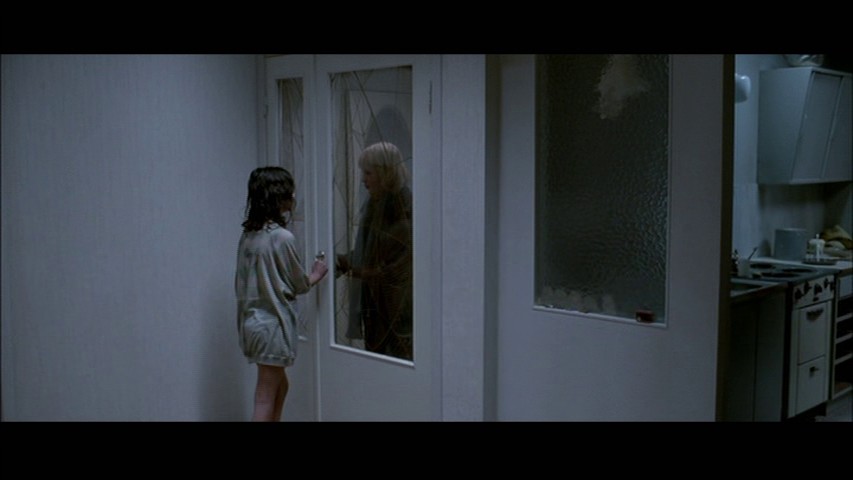
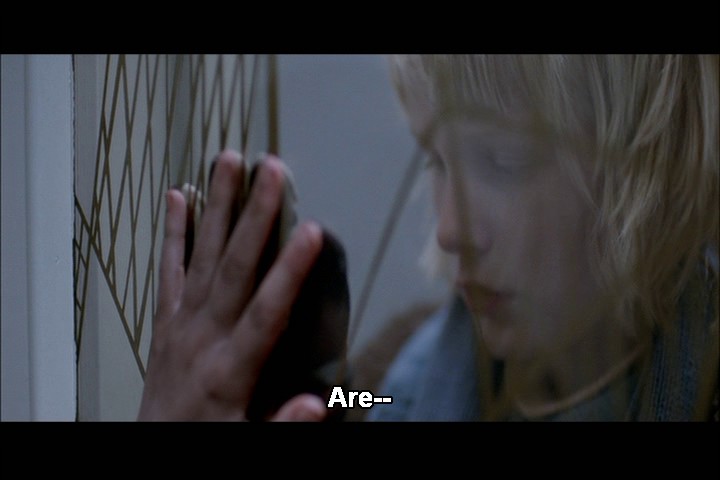
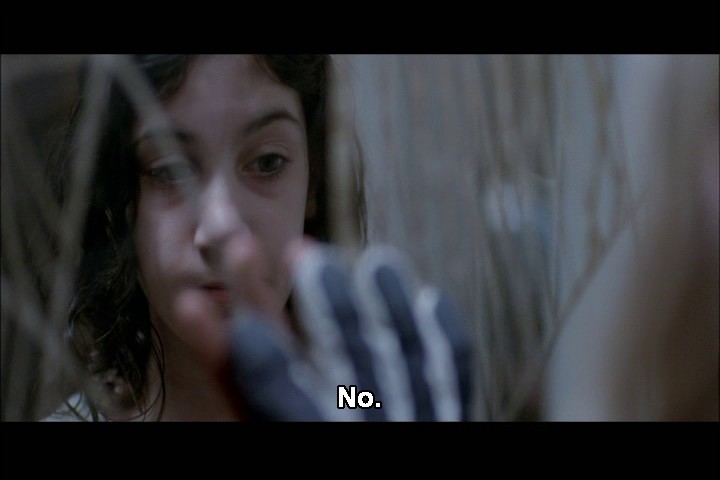
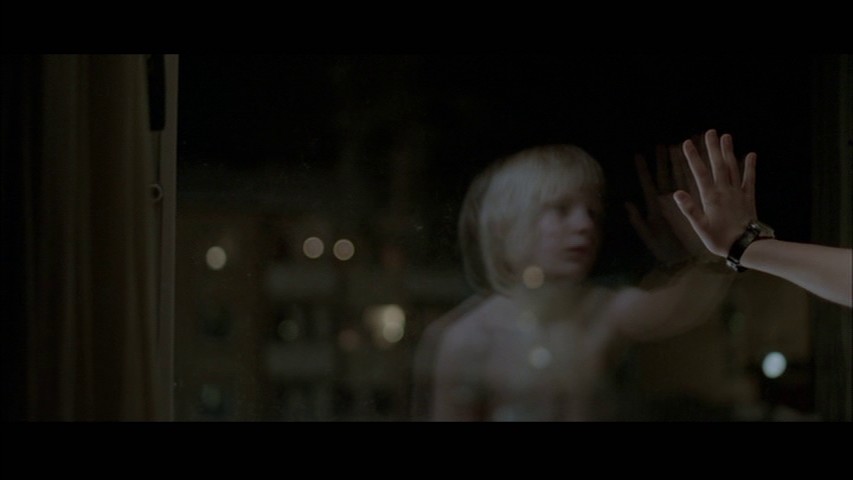
One of my favorite moments in the film is the door/touching moment when Oskar first confronts Eli’s state of being: Oskar comes to confront Eli about their vampirism and Eli shuts the door on him, the doorway now becoming a liminal space (as doorways often are) that both acts as a separator of the two figures and a potential transcendent connector of the two. Moreover, the transparent glass allows for a visual link as they navigate through this monumental difference moment.
Now that Oskar knows, Eli is very protective of their interior self, not quite ready to “let him in,” their closing the door on him punctuating this point. As Oskar asks his questions, their hands move on the glass, as if the hands are their cognitive reaching out for each other, the hands acting as their “self” feeling each other out as they really discover each other, the shut door acting as a buffer while they wrestle with the REAL of their situation (e.g., Eli’s abject self). After Eli has told Oskar who they really are – and he hasn’t abandoned them – they open the door as if to signal that they are ready to “let him in,” Oskar then being the one to decide whether he will “let Eli in.” In addition to this idea, we get this interesting mirror moment, again revealing just how they mirror each other, their outsider (Other) status. Of course, we get Oskar’s unconditional acceptance for Eli when he saves their life later and then of course when he leaves with Eli. For good or ill – and it may be a decision that will lead him down a horrible path – he has wholly let Eli “in” to his being and that is a profound thing indeed.
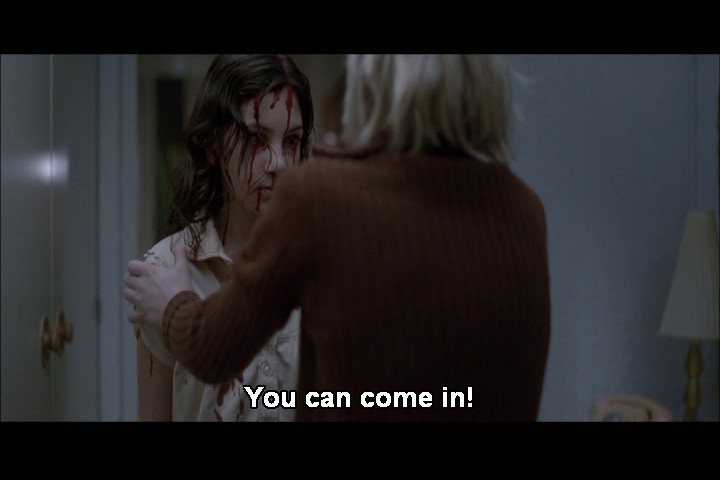
Where we also especially see this “let the right one in” sensibility play out is in the moment when Eli tells Oskar that he has to invite them in. When Oskar mocks Eli’s dictate, we get an extraordinary moment, Eli entering without an invitation. In this crucial moment, Eli puts their faith and perhaps their very life in the hands of Oskar, one of many moments where Oskar and Eli have to put faith in having “let the right one in” to their lives. In that sense, each must make a leap of faith and give their trust and loyalty and unconditional acceptance in equal measure.
I think there is something else here as well, in that this film is really a coming of age film for Oskar, and this moment of Eli entering without an invitation becomes a learning moment for him, in that his own cruelty and unconditional faith in what Eli says (in not accepting Eli’s need to be “invited” in) has consequences and hurts the one he loves, not to mention that he sees someone give the ultimate to him (Eli’s faith in him) at the cost of self.
“Be Me a Little”
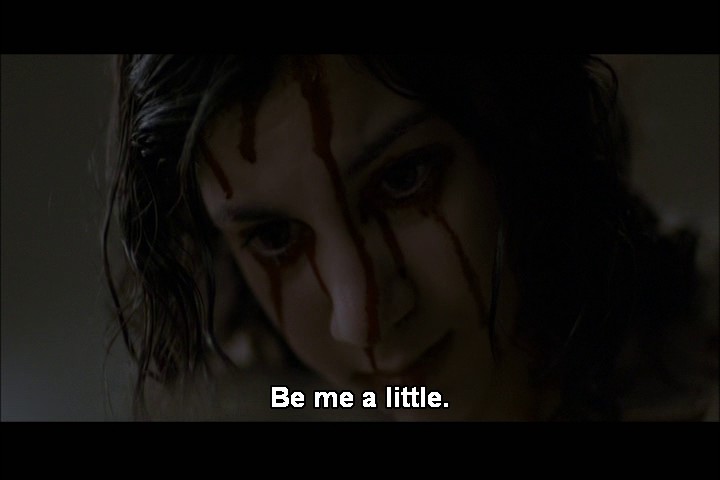
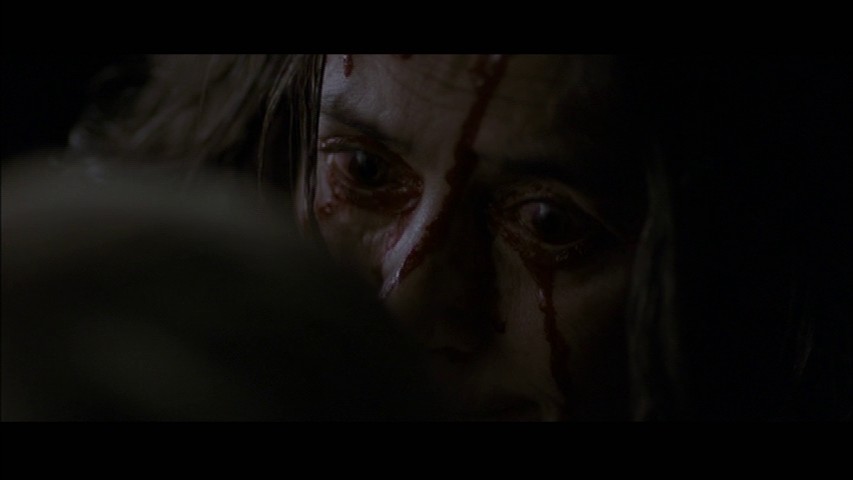
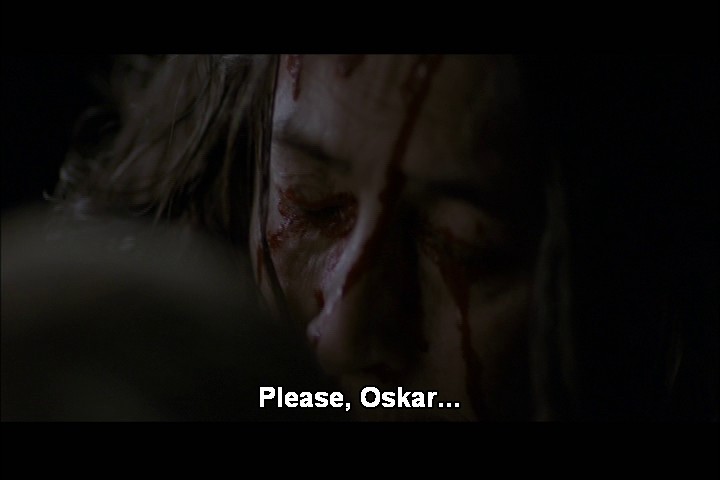
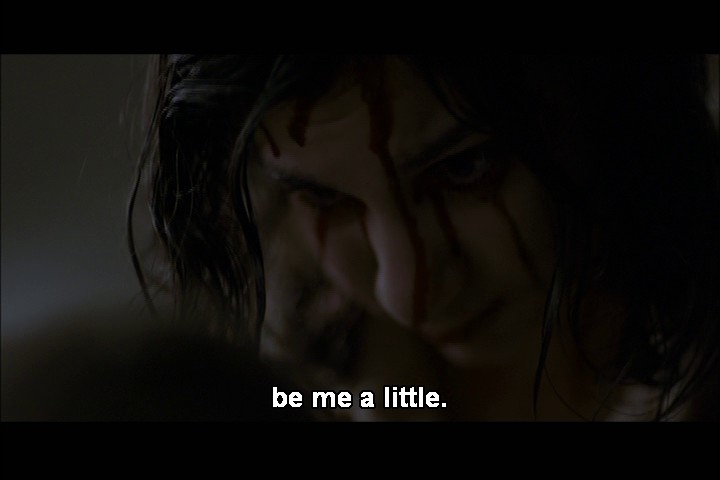
After this “invitation” moment, we get that other extraordinary moment when Eli tells Oskar to “Be me a little” and seems to somehow get Oskar to see who Eli really is, Eli’s image changing to an old woman’s visage. This moment becomes the classic “walk a mile in my shoes” idiom, another way to express having empathy for Others, to see their selves through their eyes instead of judging them from an outside (self-centered) perspective. Eli understands and relates and empathizes with Oskar. The question, then, is can Oskar do the same for Eli? I think when he says he can love Eli despite not being a “girl” and, one can assume, deciding to continue their relationship after this moment, know that Eli is really a very old woman, not to mention saving Eli’s life and then going with them, we see that he can and does.
More generally, to me, that image of Eli “bleeding” is just so, so evocative, suggesting the permeability of us. After all, our bodies are boundaries as well, a boundary between inside and outside, and when the inside leaks through, we are forced to face our own abjection, our own mortality, our own fragility. In the case of Eli, for as strong as they are, they are also incredibly fragile, this bleeding moment both reflecting Eli’s literal vulnerability, but also their figurative vulnerability, Eli’s real need for companionship and the love and unconditional acceptance that comes with it. In this context, Eli is like anyone else, a vulnerable being who can be hurt just like anyone else. In this context, this is how the filmmakers create such a complex Eli, humanizing them to such a degree that we do come to relate to them, despite Eli being a killer.
The Nature of Eli and Oskar’s Relationship
As the film expresses, it is just so apparent that in this disconnected, self-absorbed world, real bonding, real (emotional) intimacy is just so lacking. In the case of Eli and Oskar, we have two individuals just SO hungry for real bonding, physical (though not sexual) and emotional and psychological bonding. We especially get this symbolized in the Morse Code thread, which speaks to these two kindred spirits having their own “language” so to speak, they have so integrated their very being into each other, a truly rare thing with individuals, to form that profound of a union.
Further, now while I think Oskar’s initial desire is a pre-pubescent sexual desire for Eli, as he comes to know the truth of what they are, Oskar loves Eli nonetheless. That “truth” entails three facets of Eli, that they are not a 12 year old, that they are a killer vampire, and, most importantly, again, that they are not a “girl,” the latter of which is punctuated by the fact that they don’t even have female genitalia or male genitalia for that matter. This choice to make Eli non-binary is especially just so transgressive. That is, Eli and Oskar’s relationship transcends sex/gender binaries and sexual orientation (heteronormativity/homosexuality); they love each other because of what they bond over, again, unconditional acceptance of their Otherness, not to mention those elements that bond all loved ones, love, shared vulnerabilities and traumas, nurturing each other and so on. Eli has already transgressed these “norms” but for Oskar to not care that Eli is not a “girl” and that they apparently can’t be sexually intimate (or at least not have sexual intercourse) is especially transcendent.
And, then, as we become sutured into Oskar’s perspective, we then have to put ourselves in his place and also (one would hope!) accept Eli as they are, or, well, at least the sexless part.
Finally, as I touch on before, the other profound dynamic in this relationship is the extreme age difference. I touch on the surrogate “mother” element above but I want to touch on one other moment, the moment when Eli accepts and eats some candy offered by Oskar. This moment would seem to not be a particularly important moment but it speaks to a deeper point, how Eli eats the candy – despite knowing it will make them sick – to “please him.” In this sense, they also do it because in the spontaneous moment, Eli wants that bonding experience with Oskar, even if it causes them suffering. That’s how deep Eli is getting with Oskar, they will do just about anything for him at this point. And, as we see by Oskar’s distressed response, he cares deeply for them as well.
The other interesting thing here is the different dynamic at work between the two. Eli is coming to care about Oskar but being an old woman, they know that Oskar is still a child and so they have to approach him like a child, which means, yes, give him these bonding moments he wants so badly but also to get him to see Eli through experiencing them. In other words, Eli knows that they can’t just tell him that they can’t eat candy. They know that being a child, he has to see for himself. Again, we see this again with Eli entering his home even though he didn’t invite them in. Eli knew what would happen, but they also knew that because Oskar is a child, they had to show him to get him to understand. In this way, we can see how Eli is as much mother figure as they are friend or someone Oskar can be intimate with, at least at this stage of their relationship.
The Monstrous Feminine
In her readings of horror, Barbara Creed coined the term “monstrous feminine,” a castrating (she-monster) or suffocating (maternal) or phallocentric busting (lesbian, castrating) feminine. Now, often this term is applied to a dominant social order that sees women in monstrous ways, though the term is not always a derogatory term (in another essay Creed applies the term to the transgressive women in The Hunger).
To my mind, Eli signifies the ultimate (abject) “monstrous feminine,” for two reasons:
They utterly deconstruct (castrates) the phallocentrism (in short, defined as “the ideology that the phallus, or male sexual organ, is the central element in the organization of the social world”) of the dominant social order. That is, due to Eli’s defunct (castrated?) genitalia, Eli is ultimately “signed” as non-binary, which means that there is no binary between sexes/genders and phallocentrism needs a binary to see itself as a way of being the empowered sex/gender. The ambiguousness of Eli is that they are neither sexes/genders, which as Creed and Kristeva says of abjection, utterly disrupts the “symbolic order,” the order in this case being that the phallus (masculine power) is part of an ordered way of thinking and being, but when the phallus (penis/masculine power) is elided, that, in turn, elides phallocentrism. In other words, since Eli is neither female nor male, that negates the phallic power of masculinity, at least in terms of how they measure their phallic dominance in terms of sex/gender differentiation.
Second, to my mind, the most abject Other in the dominant social order (abject in terms of how certain conservative/right wing institutions see them anyway) are the transgendered, because they so utterly transgress the dominant social order, making sex/gender itself a malleable (not fixed) idea, very threatening to a phallocentric order whose identity so hinges on the fixidity of patriarchal, phallocentric sex/gender differences. In this context, Eli says they are not a “girl.” We can’t be sure that they are a “boy” either though apparently Eli was a boy in the novel, a boy who was castrated. If they are a castrated “boy” and have chosen to “perform” being a girl, that too speaks to a negation of the penis/phallus, Eli’s very (transgendered) being transgressing phallocentrism by removing the phallus (penis) from the equation, yes, but in the case of transgenderism, Eli choosing to be coded as female.
Moreover, simply put, even if we think of Eli as a female — as Eli is coded at least in the early part of the film –they are stronger than men, negating (or castrating) the phallic power of men in that way as well. (Not to mention the subversive reverse penetration of men as well…!)
I should add one other interesting element: The above reading is furthered by Oskar’s androgyny and that he “does not need to embrace stereotypical masculinity in order to feel like a complete person,” yet another way that this film utterly deconstructs the phallocentric order, not to mention making toxic (bullying) masculinity the real villain in this film.
A Nihilistic Film
As I suggest above, I have really struggled with certain aspects of this film: In short, that the film seems to get us to care about Eli, a brutal killer, and that the film has Oskar, an innocent child, to go with them, the suggestion being that he will take the place of Håkan, Eli’s previous “companion,” and thus himself become a killer.
In terms of the ending of the film, as I read it, and I really can’t see how there is any other way to read it, by Oskar going with Eli, he will become Håkan, their guardian and familiar, the one who acquires blood from murdered victims so Eli can feed. When Håkan dies, and when Eli comes back to save Oskar — Oskar now choosing to go with her — we can only presume that Oskar will eventually grow up to be Håkan’s replacement. Of course, it is always possible that Eli will not push Oskar to ever kill, killing people herself to fill her consumption needs. But just by staying with her — and in all likelihood, he probably will kill for her at some point — sweet, innocent Oskar will at least become complicit in murder if not murder itself.
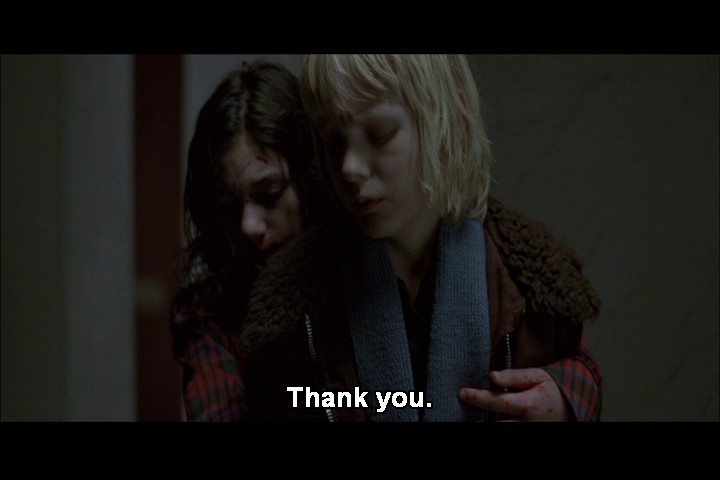

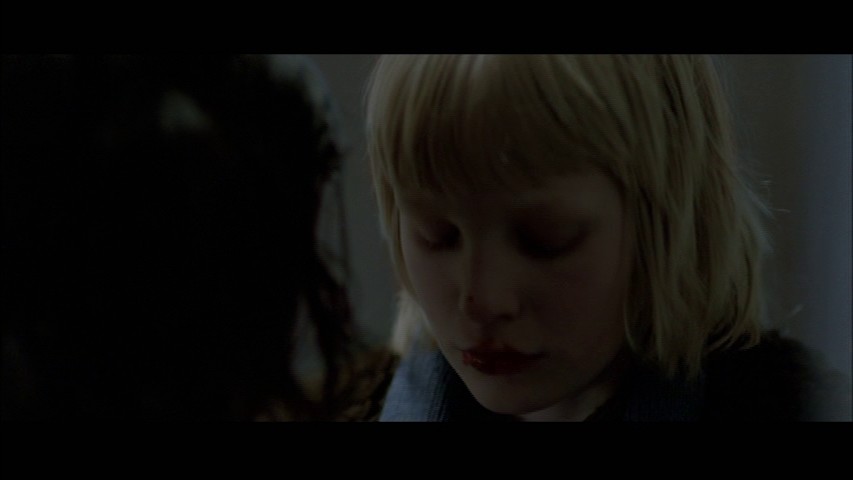
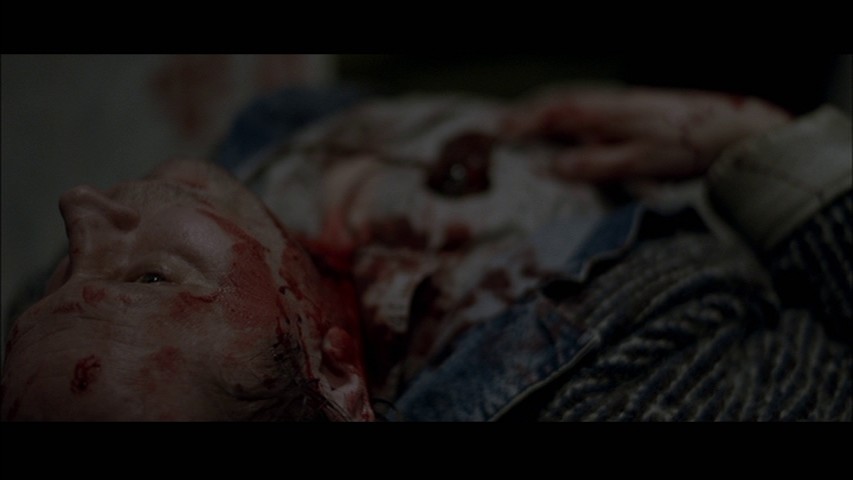

In terms of the former (“that the film seems to get us to care about Eli”), on first viewing my initial thought was that the film was manipulative. I say “manipulative” because, well, at least on first viewing, I thought that the film was, via coding Eli as a child and having them nurture Oskar and using soft focuses and sentimental music and making them a reluctant killer, “manipulating” us to sympathize and empathize with Eli despite the fact that they are a predator who preys on (good) people. On repeated viewings, I’ve more or less changed my mind on this point, and I’ve changed my mind in part because I think at least in part the film plays fair with Eli, not holding back from making their animalistic killings as abject as possible, emphasizing the truly disturbing consequences of their attack on Virginia, who is, importantly, likeable and deeply cared for by Lacke. And, then, their animalistic killing of also likeable Lacke (there is a reason why the film goes out of its way to humanize these characters) – and, again, that seemingly unnecessary shot of his dead body, along with her blooded visage (see above) – again, emphasizing to us and Oskar who Eli is, a killer.
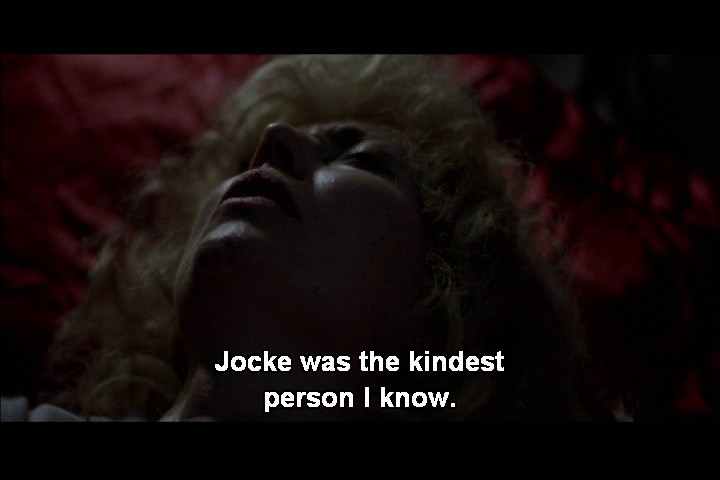
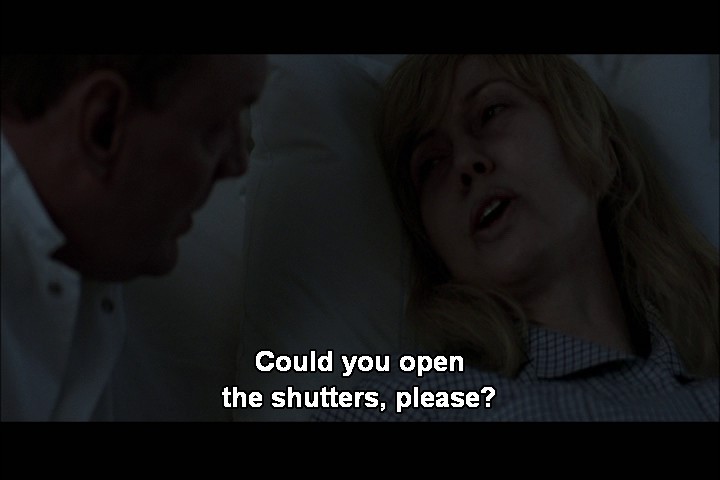

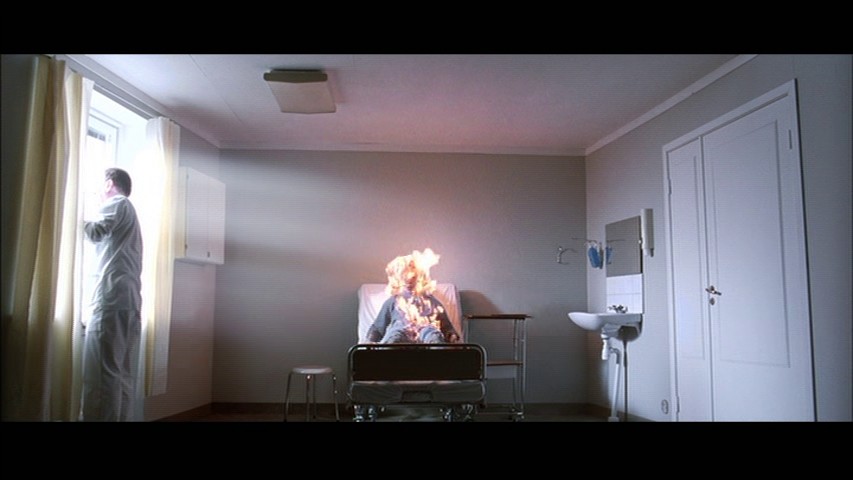
If not manipulative, then how do we square this circle, how do we reconcile our caring about Eli and accepting Oskar leaving with them?
To my mind, on repeat viewings, the film does something quite subtle though also VERY nihilistic:
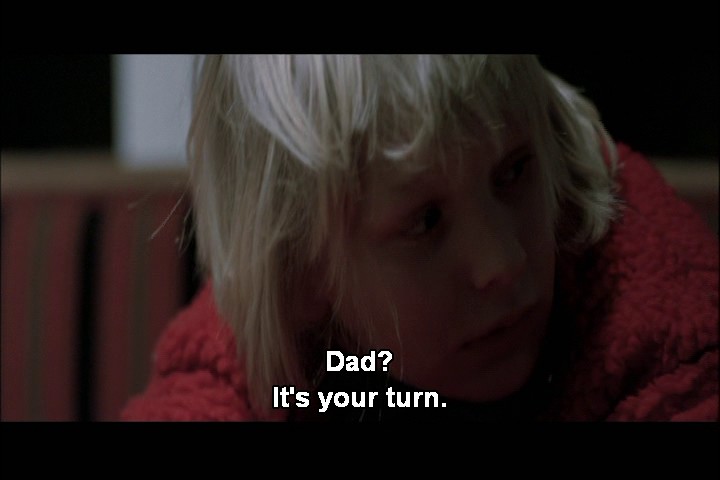
Throughout the film, the film posits a humanity that is as dark and bleak and predatory – perhaps even more so – than Eli. From the beginning, we get signifiers of brutality – the bullying, the death penalty reference, the “murder” reference by the cop talking to the class (and just the fact that he is so casually discussing murder to kids!), the many “murder” clippings in Oskar’s collection, the “murder” reference by one of the bullies, Oskar’s own murderous desire (which he acknowledges later to Eli).
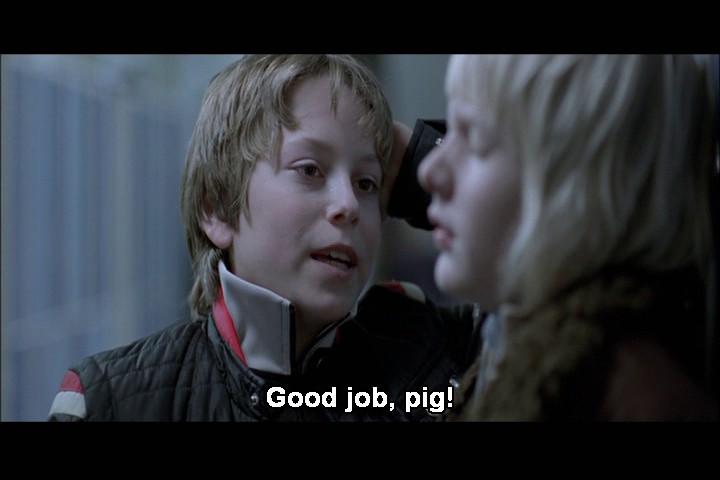
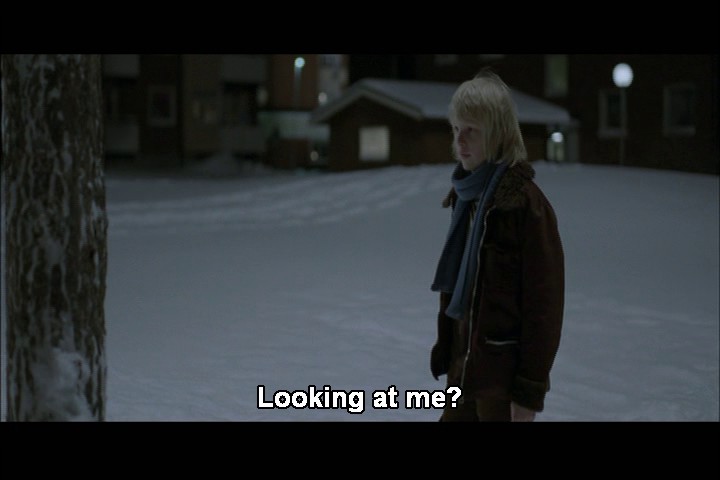
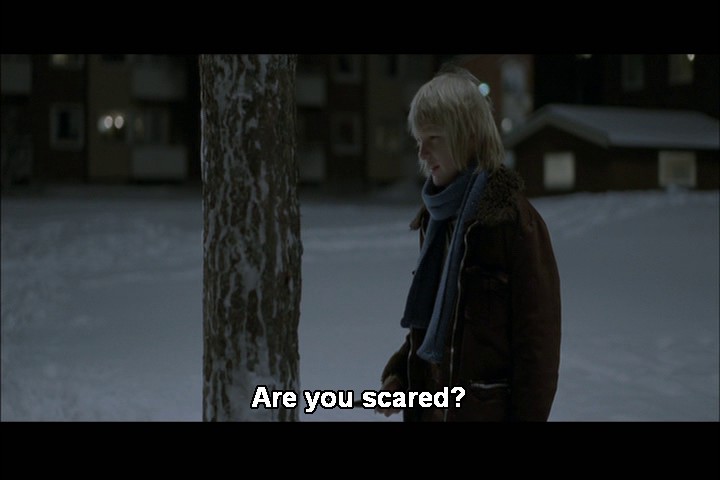
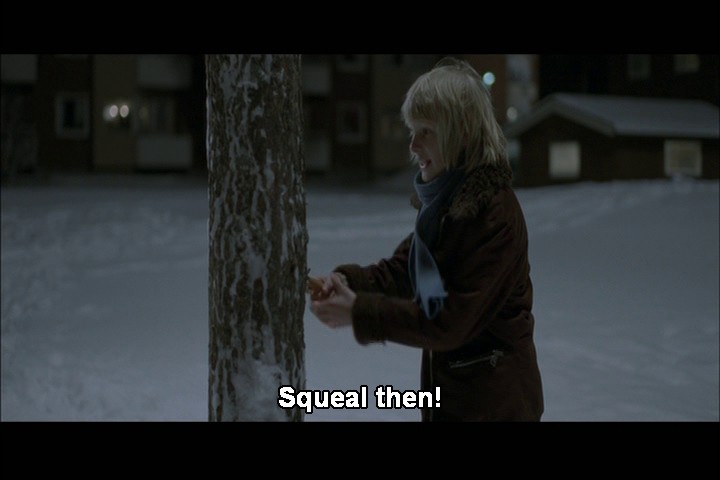
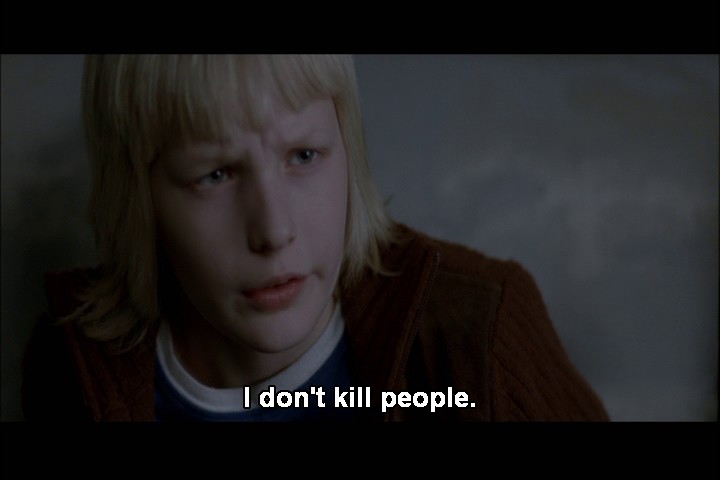
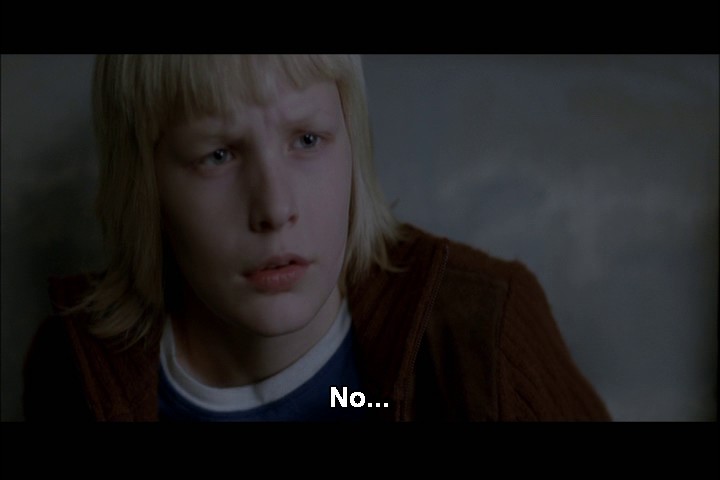
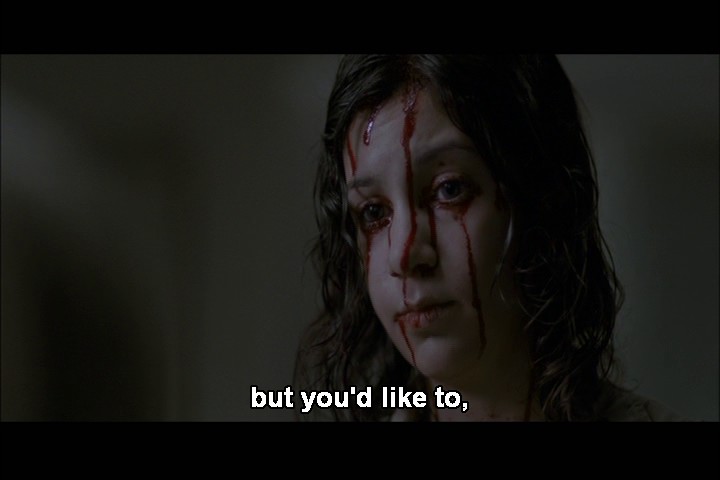
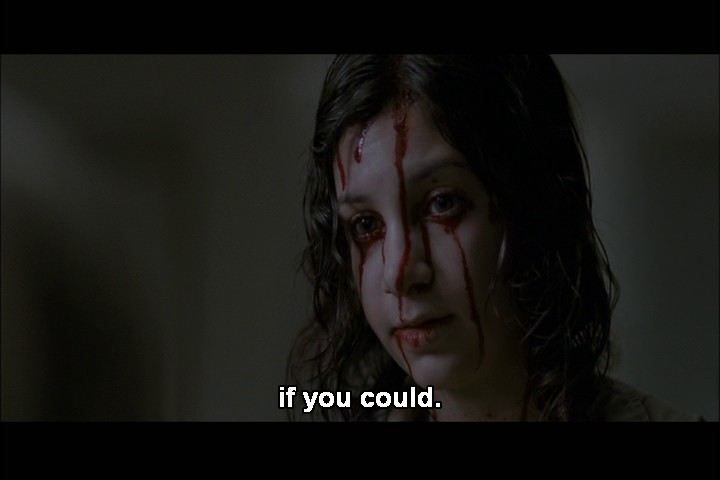
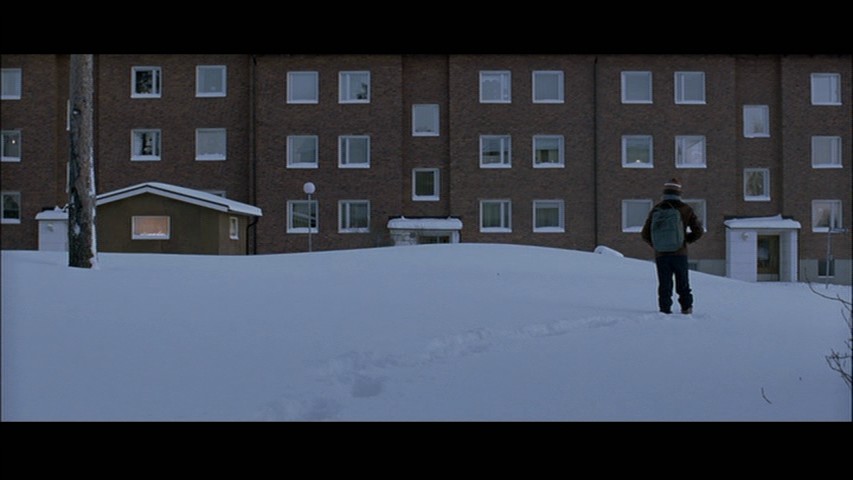
And we get signifiers of a self-centered, self-absorbed humanity (parents, adults in general), and we get signifiers of an empty, meaningless, purposeless humanity (virtually every adult in the film)! Add in the constant, permeating, hyper-emphasized desolate, bleak mise en scene (cold, bleak colors; cold, bleak weather; cold bleak, desolate looking trees; bleak lighting; darkish all the time; cold material of buildings, and so on) and we get at what I would call a nihilistic view of humanity, one indeed that Oskar would be better to “flee” than “linger,” the lingering inevitably almost certainly leading to a lack of anything enriching and perhaps even some form of what he will become with Eli, a violent individual.
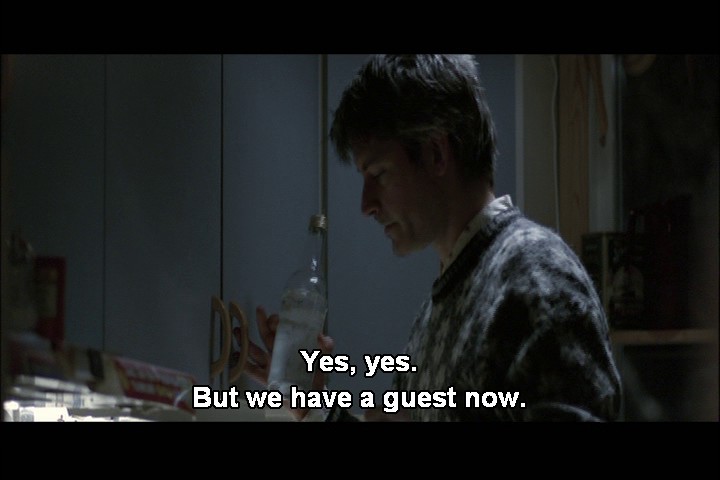
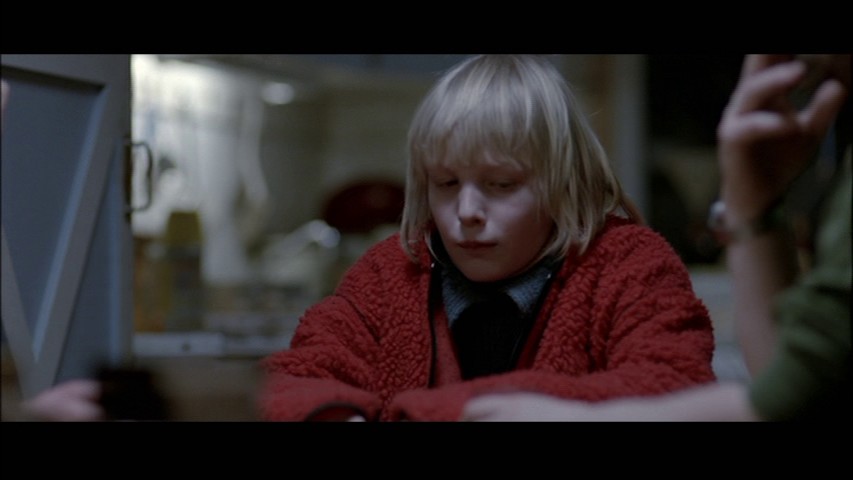
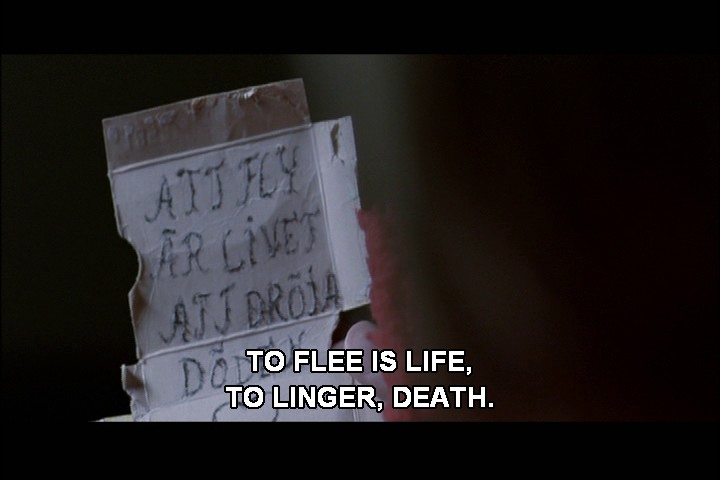
In this vein, the film seems to suggest that while Eli may be a killer, they only kill because they have to for sustenance, unlike humans, who kill for more psychopathic reasons. At least Eli offers Oskar unconditional love and attention and acceptance and an investment in his being, which, in turn, gives him a better shot at a happy and fulfilling life than what his present circumstances offers. In this crazy specific way, Eli is actually better than the humans around Oskar, though that still doesn’t negate the point above, the probable turning of Oskar into a killer as well.
Finally, what is so intriguing though, is that, contradictorily, within this frame of nihilism is a truly hopeful, sweet, tender, sensitive fable of two Others who, in finding each other, create a transcendent union. That is why I think people ignore the bleak stuff and why this film really hit a cord, because of this deep need in people to find their own someone that they can in the most intimate way possible “let in.”
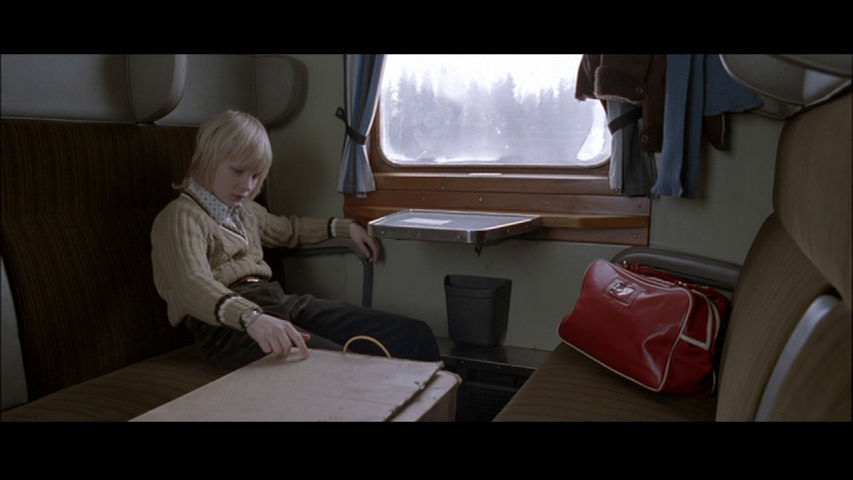
Can the Circle Be Squared?
So, ostensibly, I would say that like the geometrical truth of this idiom (a circle cannot be squared), these two threads in the film also cannot be reconciled. It is as if the film mashed up two different films, an endearing fairy tale of two lonely Others profoundly finding each other and a brutal vampire film about a murderous vampire feeding on innocent humans and influencing a child to bond with them.
Having said that, perhaps there are two ways to defend the embrace of this film. First, perhaps the commentary is that we need to make the world a better place so the Oskars of the world aren’t swayed to follow the Elis of the world. The problem with this reading is that I’m not sure it is actually in the film!
Perhaps the other way to defend an appreciation of the film is seeing it as the ultimate morality test. When we collectively see the latter nihilistic element in the film as the dominant in the film, we will know that we have evolved into a better way of thinking and being. Hmm….